
Finding a tenant is the easy part. The work that decides whether letting a Hanoi apartment from overseas goes well happens before the listing goes up and after the tenant moves in.
This guide walks the sequence in the order you will actually face it.
Step 1: Get the Apartment to a State You Can Photograph

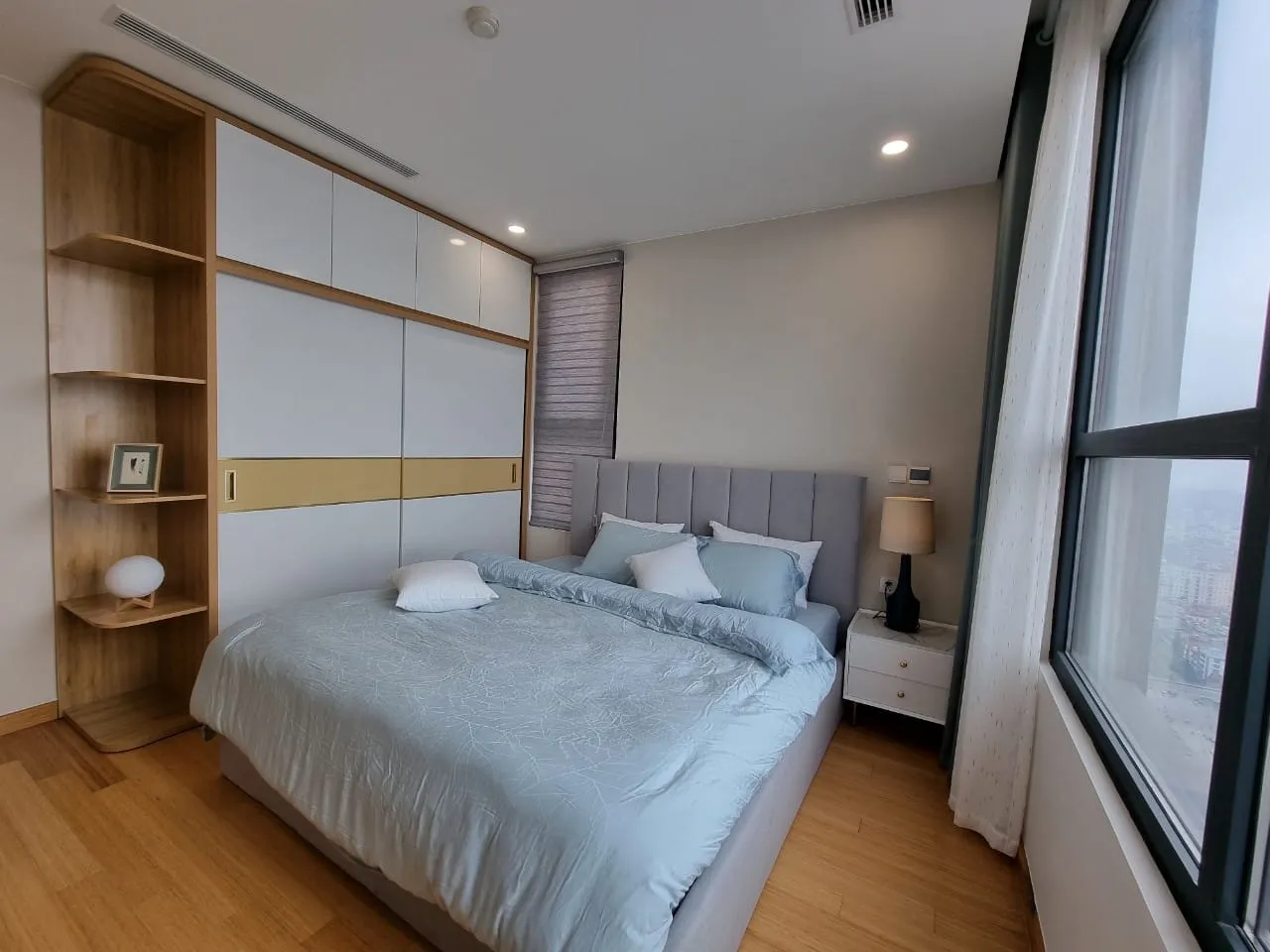
“Ready to rent” means ready to photograph and show. This unit in 6th Element was furnished by our team before listing — see Interior & Furnishing.
“Tenant-ready” is not a feeling. It is a specific state, and most apartments fail it on the same handful of points:
- Air conditioning that has not been serviced. Hanoi runs humid for months at a stretch, and an unserviced split unit smells before it fails. A tenant notices this in the first ten seconds of a viewing.
- Hot water and water pressure on the top floors. Test them. High-floor units in older towers are where this bites.
- Access cards, parking cards and key fobs. Buildings issue a fixed set and charge to replace them. Count what you have before a tenant asks for two.
- Meter readings, written down and photographed. Electricity, water and any building-billed utility. Without a baseline the first bill becomes an argument.
- Your own belongings, gone. A wardrobe with the owner’s clothes in it tells a tenant they are renting somebody’s second home rather than their own.
If the unit was handed over bare, furnishing comes before listing, not after. An empty apartment in the expat market competes against furnished stock and loses on price and on time to let.
Step 2: Decide Who the Apartment Is For, Then Furnish for Them
The tenant profile is set by the building and the layout, not by what you would prefer. A 53 m² two-bedroom in Cau Giay and a 133 m² three-bedroom a few streets away are different products and rarely draw the same inquiry.
Three profiles cover most of what we see, and each wants something different:
- Corporate and embassy tenants, concentrated in Tay Ho and Tay Ho Tay. They sign longer, pay on time, and expect the finish and the response times to match the rent. Their company often inspects before signing.
- Korean and Japanese families in My Dinh and the western corridor. School run and building amenities decide it. A unit near a school cluster lets faster than a better unit that is not.
- Professionals and university staff in Cau Giay. Value-sensitive, quick to compare, and the group most likely to leave when a cheaper equivalent opens two floors down.
Pick one before you spend on furniture. A unit furnished for nobody in particular reads as furnished for nobody.
Step 3: Set Rent Against Signed Deals, Not Listings
The listings you can see online are asking prices. The rent that matters is what comparable units in your building actually signed at, and that number is lower and harder to find.
Start from the market backdrop. Hanoi rents rose 8–10% a year over the period in which apartment prices rose 30–40%, which is why gross yields fell from 5.1% in 2023 to 3.4% in 2025 on CBRE’s figures. Rent has not kept pace with capital values, and an owner who prices from what they paid rather than from what tenants pay will sit empty.
What moves the number in practice, roughly in order of weight:
- Competing units in your own block. This is the single biggest factor and the one owners overlook. Five identical two-bedrooms listed the same week in the same tower set the price, whatever the building down the road is asking.
- Furnishing standard. An unfurnished or part-furnished unit is competing for a much smaller pool in the expat market.
- Floor and aspect. In Hanoi this means afternoon sun and noise more than view.
- Layout against the tenant. A 53 m² two-bedroom and an 84 m² two-bedroom are different products for different tenants, even in the same building.
- Timing. Corporate relocations cluster, and a unit ready in the wrong month waits.
The cost of overpricing is not the gap between the rent you wanted and the rent you got. It is the empty months while you find out. One vacant month costs 8.3% of a year’s rent, roughly double what a full year of our management fee costs at 4% of annual rent. Whether the building’s service charge sits inside the rent you quote or on top of it is decided at this step too, and that decision is worked through in who pays the property management fee.
Settle the Deposit Terms Before a Tenant Asks
Write it down before a tenant asks. Deposit amount, what it can be deducted for, how disputes over wear and tear get settled, and who returns it and within how long. A deposit argument at move-out is the most common way a routine tenancy ends badly, and it is entirely preventable at the drafting stage. What the Hanoi market treats as a normal deposit, and where three months becomes a signal, is in what deposit is standard in a Hanoi lease.
Step 4: Prepare Listing Materials
Listing photos decide whether a viewing happens at all. Shot in The Zei, My Dinh.
The listing does one job: turn a scroll into a viewing. Everything else follows from that.
Photographs decide it, and the failure mode is always the same. Phone snaps taken at night, shot from the doorway, with the lights off in half the rooms. Shoot in daylight, shoot every room including both bathrooms, and shoot the view from the window even when the view is ordinary. A tenant who cannot see the view assumes you are hiding it.
Write the rest so it screens for you. Exact size and bedroom count, the building by name, what furniture and appliances are included, the rent and deposit, the lease length you want, and your position on pets, smoking and parking. Every fact you leave out becomes an inquiry you have to answer by message, and most of those inquiries end in nothing.
Step 5: Screen Before You Show, Not After
Screening after a viewing wastes the viewing. Ask before.
What you are checking for is stability rather than income. A tenant on a two-year posting who intends to stay is worth more than one paying 10% more for a year, because the churn arithmetic runs against you: one vacant month plus a re-letting fee costs about 17% of a year’s rent, which no realistic rent increase recovers.
So the questions that matter are how long they expect to stay, how many people will live there, who the employer is, whether there are pets, and whether anyone else needs to approve the lease. Corporate tenants often have a company signatory who has not seen the apartment yet, and finding that out at signing rather than at inquiry costs a week.
Step 6: Put the Lease and the Move-In Record in Writing
The lease covers rent, deposit, payment date, term, what is included, who fixes what, and notice on both sides. Where the tenant is foreign or you are overseas, run an English version alongside the Vietnamese so nobody is agreeing to a document they cannot read.
The move-in record is the part owners skip and later need. Photograph or film every room, log the meter readings, list the furniture and appliances with their condition, and record which keys and cards were handed over. Both sides sign it.
That record is what settles a deposit dispute two years later. Without it the argument comes down to two memories, and the tenant’s is the one holding your deposit money hostage.
Step 7: Set Up Reporting You Do Not Have to Chase
Rent tracking that lives in a chat thread is not tracking. Once a month, at the same point in the month, you should receive a statement showing rent received, expenses paid with receipts attached, anything that needed maintenance, the net figure reaching you, and any decision waiting on you.
The test of a reporting system is what happens in a bad month. When rent is late, does the report say so on schedule, or does the report simply not arrive? A manager whose reporting goes quiet exactly when something is wrong has given you the opposite of visibility. What the lease sets in motion when rent actually stops is in what happens if my Hanoi tenant stops paying rent.
We send monthly statements in English for this reason, with inspection photos attached.
Step 8: Agree the Repair Rules Before Anything Breaks
Repairs are routine. Arguments about repairs are not, and they come from rules nobody set in advance.
Four things need deciding while everyone is calm. Who the tenant contacts, which is a local number rather than your inbox in another time zone. What can be fixed immediately without asking you. The spending figure above which you must approve first. And what counts as an emergency where someone acts and tells you afterwards, because a burst pipe at 2am in Hanoi does not wait for a reply from Hong Kong.
Set that last threshold too low and you will be woken for a tap washer. Set it too high and you will find out about the water damage from the ceiling below.
Tax on Rental Income: The Threshold Moved to VND 500 Million
If you read this anywhere else, check the date. The rules changed at the end of 2025, and most English-language guidance still describes the old regime.
The old rule. Under Circular 40/2021/TT-BTC, an individual landlord paid 5% VAT plus 5% personal income tax on rental turnover once annual rent passed VND 100 million. Crossing the line taxed the whole amount.
The new rule. Two laws passed on 10 and 11 December 2025:
| Law | Effective | Change |
|---|---|---|
| 149/2025/QH15, amending the Law on VAT | 1 January 2026 | VAT threshold for households and individuals raised from VND 100 million to VND 500 million a year |
| 109/2025/QH15, new Law on Personal Income Tax | 1 July 2026 | Personal income tax threshold raised to VND 500 million. Leasing taxed at 5%, applied only to the portion of revenue above the threshold |
Note the two effective dates. VAT moved in January 2026, personal income tax moves in July.
The shift from a cliff to an allowance is the substantive part. Under the old rule an owner just above the threshold paid tax on everything. Under the new one, tax applies only to the excess.
VND 500 million is about USD 19,000 a year, or roughly USD 1,600 a month of rent at early-2026 exchange rates. Many one and two-bedroom lettings in Hanoi sit below that. Whether yours does depends on your rent, the exchange rate on the day, and whether you own more than one apartment, because the threshold applies to you rather than to each unit. Three rent levels worked through at the same exchange rate are in the rental income tax guide. Confirm your own position with a licensed Vietnamese tax advisor.
Analysis of both laws: Baker McKenzie, January 2026 and EY Vietnam on Law 109/2025/QH15.
Keep the records organized from the first lease. Tax receipts, the lease itself and the purchase file are what a bank asks for when you remit rent overseas.
One document detail worth checking before you sign a new lease: Hanoi abolished its district tier on 1 July 2025 and replaced 526 commune-level units with 126 wards and communes. Your apartment’s address on paper changed. A lease drafted from an old template will carry an address that no longer matches your ownership certificate.
This article is general information only and is not legal, tax, or financial advice. Consult a qualified Vietnamese lawyer, licensed tax advisor, or relevant financial institution before making decisions.
Doing This Yourself From Overseas
Every step above is doable from abroad except four: showing the apartment, meeting a contractor, signing in front of a notary, and being the phone number a tenant calls at 2am. Those four are why most overseas owners stop doing it alone, usually after the first repair rather than the first tenancy.
If you would rather delegate the local half and keep the decisions, that is what our Property Management service is, at 4% of annual rent. Tenant sourcing is one month’s rent and falls due only when a tenant signs. Furnishing packages start at $4,000 for a one-bedroom, and Interior & Furnishing covers what a unit needs to compete.
Contact Cozyhome with the building name and layout, and we will tell you what letting it actually involves.